
E-Invoice Malaysia 2025: What It Means for SMEs and Retailers
By IRS Software Admin
E-Invoice Malaysia 2025: What It Means for SMEs and Retailers
With E-invoice Malaysia becoming mandatory in 2025, SMEs and retailers are seeking efficient ways to stay LHDN compliant while simplifying invoicing and sales operations. The challenge? Managing compliance without disrupting daily business. Manual invoicing is time-consuming, error-prone, and lacks the digital transparency now required by LHDN.
That’s where IRS ALAYA Cloud POS comes in — an e-invoice–ready POS system designed to simplify compliance while helping your business operate smarter, faster, and greener.

What Is E-Invoice Malaysia?
E-invoice Malaysia is a digital tax invoicing system introduced by Lembaga Hasil Dalam Negeri (LHDN) to modernize how Malaysian businesses report and manage transactions. Instead of paper or PDF invoices, businesses must now issue structured digital invoices that are automatically transmitted to LHDN in real time for validation.
The initiative supports Malaysia’s digital economy vision and aims to enhance transparency, reduce tax evasion, and simplify recordkeeping for businesses. E-invoicing applies to all business-to-business (B2B), business-to-consumer (B2C), and business-to-government (B2G) transactions. For more details, visit LHDN E-invoice guidelines or learn about the PEPPOL e-invoice standard.

Benefits of Digital Invoicing for Malaysian SMEs
For small and medium businesses, compliance may seem like an added task — but it’s also a big opportunity. With e-invoicing, SMEs can:
- Reduce manual work — automated invoicing saves time and minimizes data entry errors.
- Stay compliant — meet LHDN’s reporting requirements without extra paperwork.
- Gain better cash flow visibility — every transaction is recorded digitally, making reconciliation easier.
- Build customer trust — accurate, official digital invoices improve business professionalism.

LHDN Compliance Requirements (2025–2026)
LHDN has released a phased rollout schedule for e-invoice implementation. Businesses must comply according to their annual revenue tier:
- August 2024: Companies with revenue over RM100 million
- January 2025: Companies with revenue between RM25 million and RM100 million
- July 2025: All remaining businesses (including SMEs and retailers)
- 2026: Full adoption across all transaction types and industries
To comply, businesses must issue and store digital invoices in the approved PEPPOL format, include mandatory fields (buyer, seller, tax details, etc.), and maintain a proper audit trail for at least seven years.
How IRS ALAYA Cloud POS Simplifies E-Invoice Compliance
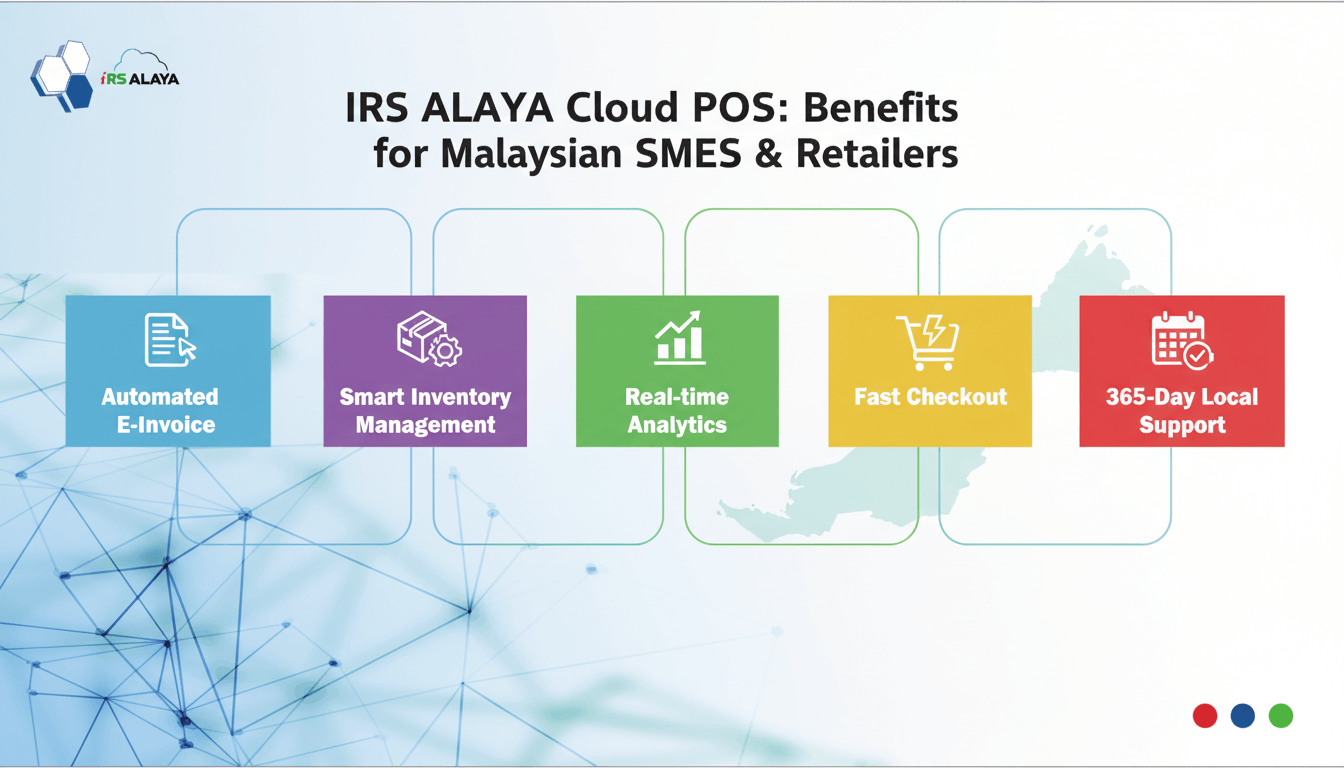
IRS ALAYA Cloud POS helps businesses stay compliant while optimizing operations. Here’s how:
- ✅ Automated E-Invoice Integration — Automatically generates and submits e-invoices to LHDN.
- ✅ Real-Time Sales Sync — Keep all branches connected with centralized data updates.
- ✅ Multi-SKU Management — Perfect for hardware shops, convenience stores, and pharmacies with large inventories.
- ✅ Cloud Access Anywhere — Monitor sales and inventory in real time, from any device.
- ✅ 365-Day Local Support — IRS Software provides continuous technical and compliance assistance.
Future-Proof Your Business with E-Invoice Malaysia
Transitioning to e-invoice isn’t just about compliance — it’s about future-proofing your business. With IRS ALAYA Cloud POS, you can focus on growing your retail operations, enhancing customer experience, and staying ahead in Malaysia’s digital economy.

Ready to simplify your E-Invoice compliance?
Request a free demo and see how ALAYA helps your business grow with confidence.